
Thirty nine seconds into the second period of extra time at the New York New Jersey Stadium, the entire narrative of the World Cup final shifted on a single strike from Ferran Torres. That moment did more than just secure a 1 – 0 victory over the defending champions, Argentina it crowned a tournament where Spain champions quietly tore up their old playbook.
Moving away from the endless, sometimes aimless passing of classic tiki taka, Luis de la Fuente’s side showcased a faster, far more vertical style of football. This second World Cup title wasn’t down to luck; it was the result of total possession control, defensive press calibration, and a deliberate plan to choke out Argentina’s midfield. The Cricaza blog dissects every single action for fans like you so you never miss a tactical shift.
The Core Numbers
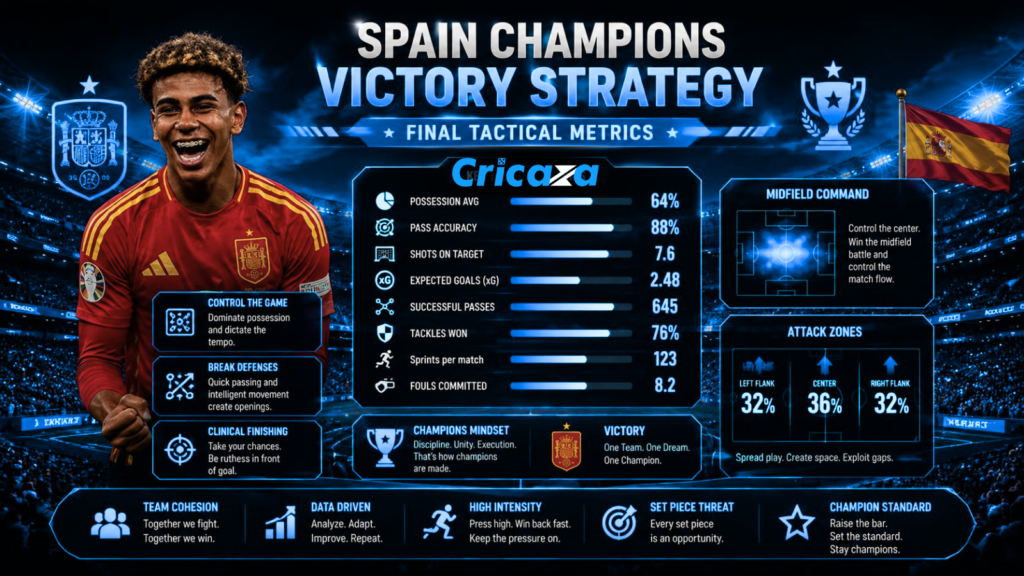
When you look at the Spain champions tactical strategy and competition data with the beat, the difference between the two teams becomes evident. A handful of indicators show how Spain champions on the whole, dictated the terms of the World Cup final match metrics:
- Possession: Spain 68% | Argentina 32%
- Passing Volume: At a 90% accuracy rate, 803 total passes completed
- Attacking Output: Spain fired 20 shots (11 on target). By contrast, Argentina was held to 3 shots, none of which hit the target.
- Defensive Resilience: During the entire tournament, Spain conceded only one goal. Yet limiting opponents to a measly 0.31 expected goals allowed (xGA) per match.
How Spain Champions Evolved
For over a decade, Spanish football meant patient, short passing triangles to keep the ball simply for the sake of keeping it. While that style built a golden era, it eventually became predictable and easy to sit deep against.
De la Fuente kept the fundamental principle of dominating the ball but injected a sense of urgency. Under his management, the team looks to advance forward immediately rather than recycling possession sideways.
Passing With a Purpose
This shift is glaringly obvious when you look at Spain champions recent tournament history. During their past two World Cup exits, their share of forward thinking passes sat well below the tournament average. That number spiked during their recent European championship run and climbed even higher this summer. This wasn’t an organic shift; the coaching staff specifically tailored midfield possession control training sessions to reward quick, forward decisions the second the ball changed hands.
Full Backs as Attacking Weapons
Pedro Porro and Marc Cucurella weren’t strictly tasked with holding a defensive line. Both full backs pushed incredibly high up the pitch, hugging the touchlines to stretch Argentina’s back four wide. While sending both full backs forward usually leaves a team vulnerable to counter attacks, Spain champions tactical strategy setup relied on the midfield possession control to instantly drop back and plug the gaps, a move that paid off all tournament.
Midfield Possession Control by Rodri
Everything Spain champions built went through Rodri. He single handedly slowed the tempo down when the defence needed a breather. And even flashing a pass forward the moment an opposition line fractured. Assisted by Fabián Ruiz and Dani Olmo, he gave Spain a stable foundation that refused to rattle.
The Era of Total Control
While isolated statistics don’t tell the whole story. A few historical landmarks from this summer highlight how dominant this run was:
- The Streak: Altogether, Spain went undefeated across the whole competition. Thus extending their amazing unbeaten run to 37 straight matches.
- Historical Passing: Rodri completed 655 passes over the course of the tournament. And it is the highest number recorded by any single player at a World Cup since data collection began in 1966.
- Vertical Intent: Spain’s progressive passing share jumped to 1.09 times the tournament average. That’s a massive leap from the stagnant 0.76 mark they registered four years ago.
Key Player Impact
Glory usually goes to the goalscorers, but Spain’s triumph was built on individual sacrifices and tactical discipline across the entire squad.
Rodri’s Resurgence
Heading into the summer, there were massive question marks surrounding Rodri after a gruelling, injury plagued club season. His flawless positioning allowed the creative players ahead of him to take risks. Since his team knew that he was sitting behind them to sweep up any loose balls.
Lamine Yamal’s Unselfish Role
If you only judge a tournament by goals and assists, Lamine Yamal’s impact could seem kind of subtle on paper. But in reality his nonstop off the ball movement pulled defenders out of their lanes. And this somehow created massive pockets of space for teammates to step into. You could hear observers talk about how he switched into a more disciplined, team first role for his country. That indeed is a different thing than his more expressive club displays.
Squad Depth and Extra Time Patience
Spain champions played a significant chunk of extra time goal parameters with a man advantage after an Argentine red card. Instead of panicking and throwing desperate crosses into the box, they stayed incredibly patient. That composure stemmed from deep squad rotation throughout the tournament. When substitutes Ferran Torres and Nico Williams combined for the winner, it proved that the bench was as dialled into the system as the starting eleven.
What Argentina Could Not Solve
Argentina’s entire blueprint relied on the genius of Lionel Messi. While his individual brilliance carried them to the final, Spain built a tactical cage that isolated him entirely.
The moment Spain champions lost the ball, their immediate press cut off the easy passing lanes to Messi, snuffing out counter attacks before they could even breathe. Without those quick transition outlets, Argentina simply couldn’t get in behind Spain’s backline.
As the match dragged into extra time goal parameters, fitness levels and squad depth kind of took over in a way you could feel. Spain champions looked fresher, sharper, and more physically ready for that extra 30 minutes, while Argentina seemed to run out of ideas and energy after the sending off, and you could tell. Spain’s defensive press calibration line sat so high and controlled the space so well that they rarely had to resort to a panicked clearance inside their own penalty box.
A Blueprint for the Future
Spain champions World Cup was a feat in mixing defensive grit with something almost relentless, proved by holding Argentina to zero shots on target over 120 minutes, plus suffocating pressure they kept applying again and again. This wasn’t some lucky breakaway or a smash and grab result. Spain meticulously drilled tactical strategy system produced this inevitable outcome. All in all, executed to perfection under the highest demands you can imagine.
Analysts will be studying this specific performance for a long time, not for the drama of the extra time winner but for the brilliant tactical evolution that made it possible. Read more on Cricaza for further breakdowns of World Cup, and check the linked coverage for upcoming match details.